Maguire
Mariners' Museum, Uncurated Search Results
Type: Bugeye
Year: 1892
Builder:
Location:

These records are found in the online catalog of The Mariners’ Museum and Park in Newport News, Virginia. Uncurated search results are presented to give researchers and interested readers an idea of whether the museum’s archives contain information about this vessel and whether it may be worthwhile to visit the museum’s catalog search page for further investigation. Uncurated results may be inaccurate or incomplete.
Search mode: Exact Name. Search phrase(s): "Maguire". Results returned: 27. Results displayed in this table: 27.
Use these buttons to send uncurated search results to your own app or text document for further research. First, check the box for any row, or click "Select All" then uncheck any rows. Then click "Show Selections". You can then copy your selections from the text box and past them into your app.
| Fetch? | Row ID | Media | Date | Vessel | Place | Related Places | Inscription/Marks | Subject | Notes | Archive Number |
|---|---|---|---|---|---|---|---|---|---|---|
| 1 | 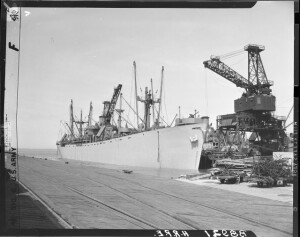 | 7/27/1944 | James G. Maguire (Steamship : 1943). | B8921 - Broadside view of the HR 500 docked at the north side of Pier 8, HRPE, Newport News, Va. just prior to sailing. 7-27-44 Official Photograph, U. S. Army Signal Corps, HRPE, Newport News, Va. 4/20/44 "CONFIDENTIAL" stamped in red ink | Front quarter view of the James G. Maguire at pier. | P0003/01-#B-8921 | ||||
| 2 | 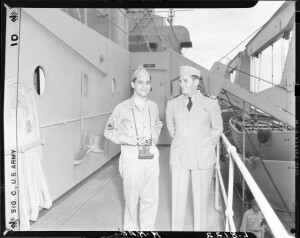 | 6/7/1944 | General W. A. Mann (Transport : AP-112). | L8122 - T/Sgt. J. Shere and Captain of SS. Gen. Mann aboard ship 6-7-1944 Official Photograph, U. S. Army Signal Corps, HRPE, Newport News, Va. handwritten in pencil: "TSgt s NCO in charge of photo lab, HRPE. Who is this Captain of the Mann?" hand written in black pen: "Capt. Paul S. Maguire -- of the Mann" "SECRET JUN 12 1944" stamped in black ink. | Embarkation (Military science). | Two men in uniform stand on the deck of the Mann. T/Sgt Shere holds a camera with a leather case and neck strap. The officer with him has what apears to be a Navy officer's insignia on his garrison cap. | P0003/01-#L-8122 | |||
| 3 | No image URL. | Civil War memoir of a boy from Baltimore : __the remembrance of George C. Maguire written in 1893. | LB107798 | |||||||
| 4 | No image URL. | Plover (Ship) | Barrow, Point, Region (Alaska)–Description and travel; Arctic regions–Discovery and exploration.; Alaska–Description and travel. | Works issued by the Hakluyt Society, 0072-9396 ; 2nd ser., no. 169-170 | Inuit–Alaska–Barrow, Point, Region | One folded leaf of map tipped in. | LB96968 | |||
| 5 | No image URL. | Surgeons–Correspondence | The sea my surgery __ __Joseph B. Maguire | LB22785 | ||||||
| 6 | No image URL. | Military chaplains–Correspondence. | Autobiography. | LB19385 | ||||||
| 7 | No image URL. | Body art.; Tattoo artists; Tattooing–Pictorial works. | Includes index. Photos courtesy of The Mariners' Museum, Newport News, Va. | LB100815 | ||||||
| 8 | 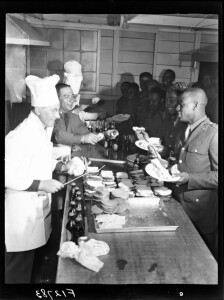 | 3/5/1945 | United States. Army–Officers.; United States. Army–Food service. | Photo shows left to right: Capt. James D. Cherven, ASN 01575853, home, Gadderville, N.Y., Commanding Offcier of 136th Port Co., Lt. Albert Torme, ASN 01059309, home, Los Angeles, Calif., Company Officer of 136th Company, Lt. William S. Maguire, ASN 01947914, home, Brooklyn, N.Y., Company Officer of 136th Port Co., Lt. Daniel E. Lewis, ASN 01051650, home, Paso Robles, Calif., 136th Company Officer, Lt. John Lanier, ASN 01059523, home, Owensboro, Kentucky, 136th Co. Officer. All Officers are pulling K.P. for 136th Port Co. on the opening and celebration of their New Day Room. Photo taken for publicity purposes at Norfolk Army Base, HRPE, Norfolk, Va. | African American soldiers. | Shows white officers behind a cafeteria counter dressed in food service attire. They are serving African American soldiers. | P0003/01-#E-12783 | |||
| 9 | 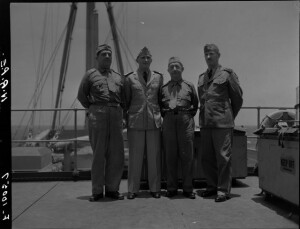 | 7/10/1944 | General W. A. Mann (Transport : AP-112).; Brazil. Exército–Officers.; United States. Navy. | F-10057 - Captain Paul S. Maguire (center) is shown with the two Generals of the Brazilian Expeditionary Forces, left to right, Brag. Gen. Euclides Zenobio da Costa, Commander 1st division of the B. E. F. Infantry, Captain Maguire, Major Gen. Mascarenhas de Moraes, Commanding General of the B.E.F and Commander McElroy, executive officer of the GEN. U.S.S. W.A.Mann. Photo taken aboard ship enroute to Naples, Italy. 7-10-44 Official Photograph, U. S. Army Signal Corps, HRPE, Newport News, Va. | Portraits, Group. | Four officers stand together in a row on the deck of the Gen. Mann for a group portrait. | P0003/01-#F-10057 | |||
| 10 | 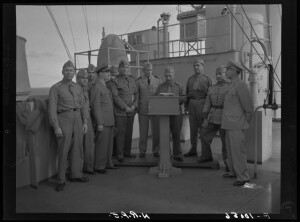 | 7/10/1944 | General W. A. Mann (Transport : AP-112).; United States. Army.; Brazil. Exército–Officers.; United States. Navy. | F-10056 - Major Gen. De Moraes, Commanding the Brazilian Expeditionary Forces, is shown addressing his troops nearing arrival to Naples, Italy. Ship's Captain Maguire is shown at his left. Photo taken aboard the GEN U.S.S. W.A. MANN. 7-10-44 Official Photograph, U. S. Army Signal Corps, HRPE, Newport News, Va. | Speeches, addresses, etc. | General de Moraes stands at a podium on the deck of the Gen. Mann, reading from a paper. He is flanked by American and Brazilian officers. | P0003/01-#F-10056 | |||
| 11 | 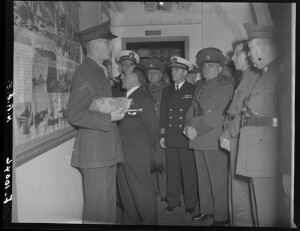 | 6/30/1944 | Brazil. Exército. Esquadrão de lutador, 1°.; Brazil. Exército–Officers.; General W. A. Mann (Transport : AP-112). | Rio de Janeiro (Brazil). | F-10046 - President Getulio Vagas, President of Brazil, is shown speaking through the ship's loud speaker system to give a word of greetign to his troops. Captain Paul S. Maguire is shown looking on. Photo taken in Rio De Janerio, Brazilm aboard the Gen. U.S.S. W.A.Mann. 6-30-44 Official Photograph, U. S. Army Signal Corps, HRPE, Newport News, Va. | Embarkation (Military science).; Speeches, addresses, etc. | Several officers stand in a room marked "Officers Lounge" while a man in a striped suit speaks into a wall-mounted PA system. A soldier stands at attention against the wall, holding what appears to be a trumpet or bugle in a piece of fabric or bag with the US Marines logo on it. | P0003/01-#F-10046 | ||
| 12 | No image URL. | "First printing." "Sequel to Rig for church" Introd. | LB19386 | |||||||
| 13 | No image URL. | See also Oct. 1957, p.1065. | LB60648 | |||||||
| 14 | No image URL. | Veendam (Passenger ship : 1996); Holland Amerika Lijn.; Holland Amerika Lijn–Art collections.; FINCANTIERI (Firm). | Cruise lines.; Ocean travel.; Passenger ships.; Shipbuilding.; Ships in art.; Corporations–Art collections; Black corals. | "Holland America Line a tradition of excellence" Cover. Includes index of advertisers. A "Statendam class" ship. Cover illustration: painting of the M/S Veendam IV by Capt. Stephen J. Card. Includes a list of facts & figures of the M/S Veendam IV. Includes descriptions of the works of artists: Frank Lisser, Peter Hartwig, Tim Maguire, Wout Muller, Luciano Vistosi, Joop Clobus, Capt. Stephen J. Card, M. Rees Marlatt, Susanna Holt, Kathy Haines Dench, architect: F.C.J. Dingemans; designers: Kym Anton and Joseph Farcus. Includes an adaptation of the article: Black beauty in coral : through the eyes of the artist / Dick Shelby. | LB96460 | |||||
| 15 | 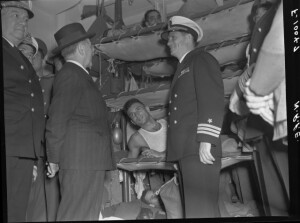 | 6/30/1944 | Brazil. Exército. Esquadrão de lutador, 1°.; Brazil. Exército–Officers.; General W. A. Mann (Transport : AP-112). | Rio de Janeiro (Brazil). | F-10047 - Presiden Vargas is shown inspecting sleeping quarter of his troops aboard the Gen. U.S.S. W.A. Mann, while Captain Paul S. Maguire looks on. 6-30-44 Official Photograph, U. S. Army Signal Corps, HRPE, Newport News, Va. | Embarkation (Military science). | Several officers and a man in a civilian suit stand in the enlisted men's sleeping quarters. Pres. Vargas speaks with one of the men in the bunks. | P0003/01-#F-10047 | ||
| 16 | 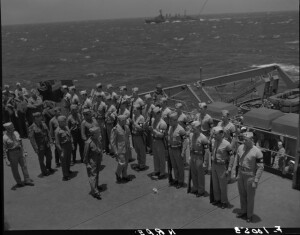 | 7/10/1944 | General W. A. Mann (Transport : AP-112).; United States. Army.; Brazil. Exército–Officers.; Omaha (Light cruiser : CL-4) | F-10053 - Major Gen. Mascarenhos De Moraes, inspects the Marine Guard aboard the GEN U.S.S. W.A. MANN. With the Gen. is ship's Captain, Paul S. Maguire. U.S.S. OMAHA can be seen in the background. Photo taken enroute to Naples, Italy. 7-10-44 Official Photograph, U. S. Army Signal Corps, HRPE, Newport News, Va. | Military ceremonies, honors, and salutes. | American soldiers with MP armbands stand at attention in two on the deck of the Gen. Mann. A group of American and Brazilian officers passed in front of them for inspection. | P0003/01-#F-10053 | |||
| 17 | 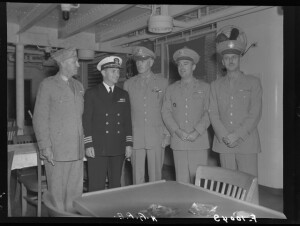 | 6/30/1944 | General W. A. Mann (Transport : AP-112).; United States. Army–Officers.; United States. Navy–Officers. | Rio de Janeiro (Brazil). | F-10049 - U.S. Military Officers of South Atlantic Area inspect ship. Left to right, Brig. Gen. Hays Kroner, Capt. Paul S. Maguire, USNR, Major General Ralph H. Wooten, Commanding the U.S.Forces in the South Atlantic, Col. Kenner Hartford and Col. P. W. Edwards. Photo taken aboard GEN. U.S.S. W.A.MANN at Rio de Janerio, Brazil. 6-30-44 Official Photograph, U. S. Army Signal Corps, HRPE, Newport News, Va. | Embarkation (Military science). | Five officers, including one from the Navy, stand together in a room aboard ship with an electric light on the ceiling and a table with a rim around the edge. | P0003/01-#F-10049 | ||
| 18 | 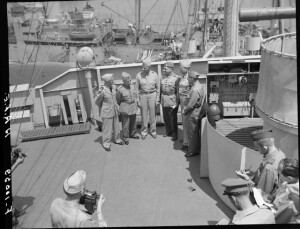 | 7/13/1944 | General W. A. Mann (Transport : AP-112).; Brazil. Exército–Officers.; United States. Navy.; United States. Army. | F-10059 - Left to right are shown, Captain Laul S. Maguire, major General de Maoraes, Lt. Jacob Devers, Brig. Gen. Zenobio De Costa, Major Gen. David Barr and Commander Raul Reis, B.E.F. Liason Officer. Photo taken from bridge of GEN. U.S.S. W.A.MANN in Naples, Italy. 7-13-44 Official Photograph, U. S. Army Signal Corps, HRPE, Newport News, Va. | Portraits, Group–Italy. | Five officers stand together on the deck of a ship for a portrait with another ship in the background. This image was shot from enough of a distance and height that it catches the pther photographers and cameramen in front of them. | P0003/01-#F-10059 | |||
| 19 | No image URL. | See alos Oct. 1957, p.1065. | LB52410 | |||||||
| 20 | No image URL. | United States. Navy–Biography.; United States. Navy–History–Sources–19th century; United States. Navy–History–Sources–20th century | Admirals–Correspondence. United States | Includes index. | LB18989 | |||||
| 21 | No image URL. | Alabama (Screw sloop : 1862).; Confederate States of America. Navy–Officers.; United States. Navy–Officers.; Shark (Schooner : 1821). | United States–History–Naval operations. Civil War, 1861-1865 | Spies–History–Civil War, 1861-1865. United States; Shipbuilding contracts–Confederate States of America. | This collection consists of spy reports, commissions, correspondence, a scrapbook of obituaries, and the "Original Contract for the Building of the Confederate States Steamship Alabama." The spy reports by Matthew Maguire include specific information pertaining to the CSS Alabama. The correspondence in this collection shows the relationship between Bulloch and members of his family as well as other officers including Francis Lawley, R. J. Armstrong, and Neil Harrison. These letters span from Bulloch's time serving in the Navy in 1847 to after his death in 1901. Also included are Bulloch's warrant as master and his Confederate States naval commission as commander. The warrant is dated 17 January 1853 and is signed by President Millard Fillmore; Bulloch's Confederate commission is dated 17 January 1862 and is signed by President Jefferson Davis. | MS0283 | ||||
| 22 | 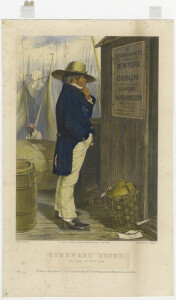 | SHORT DESCRIPTION: Poster for WASHINGTON shown in print. | CL9882 | |||||||
| 23 | 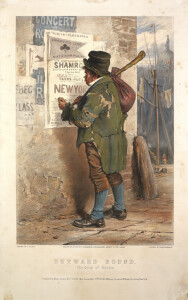 | OUTWARD BOUND, THE QUAY OF DUBLIN | CL9881 | |||||||
| 24 | No image URL. | United States–History, Naval–Sources. | Naval letters series ; 4 | Letters and papers of Alfred Thayer Mahan __ __edited by Robert Seager II and Doris D. Maguire | LB8702 | |||||
| 25 | 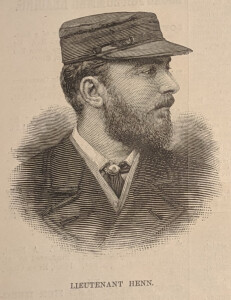 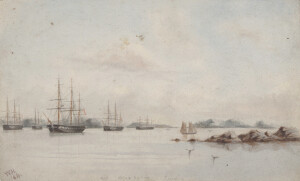  | SHORT DESCRIPTION: Watercolor drawing by Lt. William Henn showing the Royal Navy's Baltic Fleet anchored off Waxholm, Sweden in 1862. Five ships are anchored at the left side with a hilly coastline behind. To the right of center is a small schooner under sail with hills behind and rocks and birds in the foreground. NOTES: Extracts from the Times: July 15, 1862: The Channel Fleet have received orders for sea, and, according to arrangements existing yesterday, will sail from Spithead to-day for the Baltic, calling in at the Downs for pilots. The present intentions are for the fleet to proceed in the first instance to Stockholm, and afterwards to Riga, calling at Copenhagen on their return from the Baltic, sometime in the beginning of September. The Channel Fleet now anchored at Spithead comprises the REVENGE, 89, screw, Capt, Charles Fellowes, flagship of the Commander-in-Chief, Rear-Admiral of the Red, Robert Smart, K.H.; ST. GEORGE, 86, screw, Capt. Hon. Francis Egerton; TRAFALGAR, 86, screw, Capt. J.B. Dickson; DEFENCE, 18, screw, iron frigate, Capt. R. Ashmore Powell, C.B.; EMERALD, 40, screw, Capt. A. Cumming; GALATEA, 28, screw, Capt. Rochfort Maguire; CHANTICLEER, 17, screw, Commander Charles Stirling; and TRINCULO, 2, screw gunboat, of 60-horse power, tender to the Revenge, flagship. The WARRIOR, 40, screw iron frigate, Capt. Hon. A.A. Cochrane, in dock at Portsmouth, is detached from the Channel fleet, and consequently will not accompany the ships on their Baltic cruise. The WARRIOR will be undocked at Portsmouth to-day, and is expected to proceed round to the Mersey, beyond which she has no orders to extend her cruising at present. July 16, 1862: The Channel Fleet sailed from Spithead yesterday for the Baltic. At 4 p.m. all the ships, with the exception of the CHANTICLEER, had weighed and stowed their anchors. The EMERALD frigate led the way out of the anchorage under her three topsails, jib, spanker, and foretopmast staysail, before a strong westerly breeze, followed by the Revenge, carrying Rear-Admiral Smart's flag, under her three topsails, jib, and foresail. The ST. GEORGE came next, under three topsails, jib, and foretopmast-staysail, succeeded by the TRAFALGAR, under the same sail, with the addition of her fore and main courses; the GALATEA, with three topsails, jib, and staysail followed, and the DEFENCE, under her double topsails, jib, and staysail, slowly moved up astern. South of the Warner light vessel the EMERALD hove to, and the Admiral's ship passing took the lead of the line. The TRAFALGAR at the same time passed the ST. GEORGE and took second place, with the ST. GEORGE third. As soon as the line-of-battle ships had assumed their proper positions, the EMERALD'S sails were filled and she fell into her place astern of the ST. GEORGE. The GALATEA came next, followed by the DEFENCE, which now let fall her fore and main courses to enable her to keep in her assigned position. As the Admiral's ship reared the Nab light vessel the CHANTICLEER had got her anchor at Spithead, and making sail brought up the rear of the line, about six miles astern of the leading ship. From the Nab light vessel a course was shaped to clear the Owers light ship, en route for the Downs, and soon after 5 p.m. the whole of the ships were out of sight from Portsmouth. August 11, 1862: PRINCE ALFRED AT STOCKHOLM. The British squadron anchored on the 4th inst. off the Fort of Waxholm, near Stockholm, where the ST. GEORGE, having his Royal Highness Prince Alfred on board, and the CHANTICLEER, had previously arrived in the evening of the 2d. The royal family of Sweden were absent from the capital with the exception of Prince Oscar, who arrived in Stockholm from Norrkoping on the morning of the 3d, and immediately started in the steam-yacht KARE to the ST. GEORGE, to call upon Prince Alfred. Prince Oscar was accompanied by the Port-Admiral of Stockholm and the members of the British Legation, and was received with a salute and manning of yards; the salute was answered by the fortress. His Royal Highness Prince Alfred arrived in Stockholm at eleven the following day, and drove at once, in a royal carriage, to return the call of Prince Oscar. Prince Alfred, who observes the strictest incognito, afterwards visited the royal armoury, the museum of antiquities, the royal palace--where luncheon, was prepared--the church on the Knight's Island, Moseshill, made a tour round the park Djurgarden in the afternoon, and dined in the evening with Prince Oscar at the royal palace. The members of the British Legation and several British officers were invited to meet his royal highness. The prince not wishing to use the apartments placed at his disposal in the palace, returned in the night on board the ST. GEORGE. Captain Sundin, R.S.N., is in waiting on the prince during his stay in Stockholm. Prince Alfred was expected to return to Stockholm at an early hour on the 5th, to make an excursion to the summer palaces of Ulricksdal, Haga, and Drottningholm, where luncheon was to be taken, during which the fountains (trophies from Prague) would play. The Prince had accepted an invitation to dine with Mr. Corbett, H.B.M.'s charge d’affairs at Stockholm, in the evening. On the 6th the fleet was to sail for the Gulf of Finland and Cronstadt. NOTES: Lieutenant William Henn, R.N. (1847-1894) was born in Dublin in 1847. Henn joined the Royal Navy in 1860 at the age of 13 and his first service was as a naval cadet aboard the HMS Trafalgar (Dublin Evening Packet and Correspondent, October 3, 1861). His next service was as a midshipman aboard the steam frigate HMS Galatea from 1862 to 1866 during the American Civil War. The ship was on the North American and West Indies station. In November 1863 the ship was off the Rio Grande in the Gulf of Mexico and in January/February 1865 it was in the Chesapeake Bay. He was present at the bombardment and capture of the forts at Cape Haytien, and at the Morant Bay Rebellion in Jamaica in 1865. | CL30943 | |||||||
| 26 | 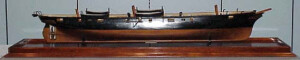 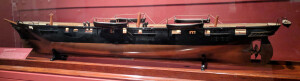 | NOTES: Probably a builder's model from Laird's once owned by James D. Bulloch, the Confederate agent in Liverpool who signed the contract for her construction. The model descended in his family to the individual from whom The Mariners' Museum acquired it and closely related documents and artifacts. This is believed to be the "builder's model in this country" which Howard I. Chapelle and William Earle Geoghegan examined in developing plans for the Smithsonian Institution's model of the ALABAMA. See file on MD 131, the rigged model built in 1962 for the Museum from those plans, for copies of relevant Chapelle correspondence. Vitrine not included in measurements, as it is not original to the model and fits around the base rather than into the groove. The wood base may also not be original, as it bears evidence of having been used with a different model. Lines and offsets were taken from this model by George Matson and Alan Frazer in 1990, and two scale drawings with this information are available from The Mariners' Museum Archives (1) Body Plan; (2) Half Breadth and Profile. An email from Stan Hobbs in 2003 indicates that there is an error in the table of offsets. The dimension given for Station 3/Waterline 2 reads 14'11-2/8" but should read 4'11-2/8". VESSEL INFORMATION- VESSEL NAME: ALABAMA, 1862 ALL NAMES OF VESSEL: 1)ALABAMA NATIONALITY: CONFEDERATE STATES OF AMERICA VESSEL TYPE: STEAM AUXILIARY SLOOP OF WAR, BARK-RIGGED SERVICE DATES: 1862-1864 SHIPBUILDER: LAIRD & COMPANY (AKA BIRKENHEAD IRON WORKS) SHIPBUILDER LOCATION: ENGLAND, BIRKENHEAD SHIP OWNERS: CONFEDERATE STATES OF AMERICA SHIP LINE OR OPERATOR: CONFEDERATE STATES NAVY CAPTAINS OR OTHER RELATED PEOPLE: BULLOCH, JAMES DUNWODY (Confederate agent, Liverpool); SEMMES, RAPHAEL (commanding); WINSLOW, JOHN (commanding, USS KEARSARGE) MAJOR EVENTS: FINAL BATTLE, 6/19/1864 VESSEL HISTORY: Confederate agent Bulloch made the arrangements for building by Laird's yard (hull 290), supposedly as a merchant ship; it was soon apparent that she was a warship; reports described her as a gunboat to be fitted out as a privateer and commanded by Captain Bulloch. Sailed on trial trip and was turned over to Semmes and Confederate crew at sea; guns brought aboard and vessel commissioned there, off the Azores. Cruised much of the world and captured or sank 67 United States merchant vessels in two years; caused many others to be sold to foreign flags. Was sunk by USS KEARSARGE, steam sloop of war, in ship-to-ship duel off Cherbourg. Wreck discovered in 1985, and successfully claimed by U.S. Navy. Some artifacts have been recovered. DATE SUNK: 6/19//1864 PLACE OF SINKING: English Channel off Cherbourg, France ASSOCIATED PLACES: FRANCE, CHERBOURG; RELATED VESSELS: KEARSARGE (victor, sank ALABAMA in battle) INVENTORY: vitrine - there is one (1) component part. | CL21352 | |||||||
| 27 | 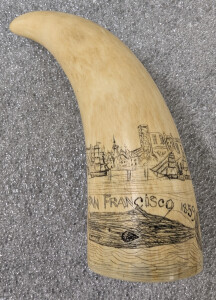 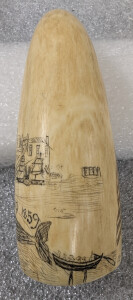 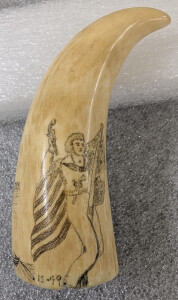 | SHORT DESCRIPTION: Sperm whale tooth engraved on obverse with harpooned sperm whale, whaleboat, and waterfront view of "SAN FRANCISCO 1859". Full-rigged ship and brig-rigged sidewheel steamer visible at wharves. The reverse side bears a stipple-style engraved view of a sailor who has climbed to the top of a flag staff and appears to be nailing an American flag to the staff with the butt of a pistol. The sailor holds an upraised pistol in his right hand and another stuck in his belt. His left hand holds the staff and his legs are wrapped around it supporting his body. He appears to be dressed as a US Navy sailor with a wide collared shirt and black neckerchief/tie around his neck. Inked in black. This tooth was acquired with a set of 84 pieces created by artist Harry Neyland (IS476-IS560) between 1934 and 1939 for collector Robert Lyons Hague, however, the artistic style of the images indicates this piece was made by another hand and may be an authentic piece of mid-19th century scrimshaw. Stylistically, the sailor scene and the San Francisco waterfront view show folk-art engraving characteristics—bolder more naive outlines, heavier stippling, and less refined shading differ from the more polished, systematically illustrative approach Neyland took in creating his scrimshaw which was aimed at creating accurate and precise illustrations of whaling terms. The line quality and handling of details (e.g., flag, pistols, waves, buildings) appear looser and more characteristic of mid-19th-century whaleman work than Neyland’s more documentary style. The explicit 1859 date and harbor view also suggest a sailor’s direct memory or souvenir, rather than a systematic series entry. Perhaps Hague acquired the tooth for the collection or Neyland acquired it as he purchased raw materials. NOTES: Richard Malley 7/10/1996: It is probable that the obverse and reverse were engraved by two different hands, most likely at different times. The obverse scene of San Francisco is possibly 20th C. while the stipple work on reverse is late 19th century. [Jeanne Willoz-Egnor, 4/10/2026] Curator Richard Malley's 1989 observation well-founded. There are enough differences in line weight, shading density, compositional approach, and level of refinement to suggest two different hands—or the same hand under markedly different circumstances (e.g., one side copied from a print or done more carefully, the other drawn more freely from memory or imagination). On the sailor side the engraving uses bold, confident outlines with relatively heavy stippling for shading on the figure’s clothing, hair, face, and the flag. The lines have a certain fluidity and energy, especially in the dynamic pose of the sailor climbing the staff and the flowing stripes of the flag. The pistols and details like the collar/neckerchief show quick, expressive strokes. There is visible cross-hatching in places, but it feels more spontaneous than methodical. On the San Francisco side the lines appear finer and more controlled overall, with denser, more systematic hatching and stippling used to render architectural details (buildings, towers, windows), ship rigging, and the foreground waves/hull. The cityscape has a more panoramic, illustrative quality, with careful perspective in the hills and docks. The inscription “SAN FRANCISCO 1859” is rendered in clear, blocky lettering that integrates neatly with the scene. There is a difference in “hand pressure” and tool handling is noticeable: the sailor side feels more folk-art direct and vigorous; the waterfront side feels more deliberate and landscape-oriented. It is not uncommon in scrimshaw for a tooth to be started by one sailor and finished or added to by another (or even acquired unfinished and completed later). The explicit 1859 date on the reverse further anchors that side to a specific moment in the Pacific whaling/Gold Rush era, while the sailor scene is more timelessly symbolic. The sailor image on IS495 is very likely inspired by (or directly adapted from) 19th-century book illustrations, prints, or popular patriotic engravings rather than depicting a specific historical event. The dramatic pose—a lone American sailor high on a flagstaff, holding the Stars and Stripes aloft while armed with pistols—fits a common romanticized motif in American maritime folk art and popular literature of the era. Scrimshanders frequently copied or freely interpreted published images from books, newspapers, broadsides, or illustrated histories, especially patriotic naval scenes, to create personal souvenirs. The scene was most likely inspired by the story of John/Jack Crawford, a 22-year old British sailor who nailed a British flag to the stump of a mast during the 1797 Battle of Camperdown to indicate the ship had not surrendered when its colors were shot away. The act popularized the idiom "nail your colours to the mast." A number of images have been published showing John/Jack Crawford nailing the flag to the mast and several have features that resemble IS495. The first image of Crawford was published by Daniel Orme on November 21, 1797. It most resembles IS495 with the exceptions being the sailor is British, his left hand holds the flag to the mast over his head while his right uses a marlinspike to nail the flag. A mezzotint published by George S. Shury in 1860 after a painting by Thomas Herbert Maguire shows the sailor in a reversed position, but in American style sailor’s clothing that is similar to that worn on the sailor on IS495. This same image was used as the frontispiece of Capt. Edward Robinson’s “The Life of Jack Crawford…” which was published in 1866. The frontispiece to the book ‘Drum-Beat of the Nation: The First Period of The War of the Rebellion from its Outbreak to the Close of 1862’ by Charles C. Coffin shows Sergeant Peter Hart nailing the American flag to the flagstaff over Fort Sumter in 1861. The book was published in 1888 and also bears some resemblance to IS495. Finally, drawings and photographs published in 1888 and 1890 show the Jack Crawford monument erected in Mowbray Park in Sunderland show Crawford nailing the flag to the mast with the butt of a pistol. It is possible that the artist of IS495 viewed one or more of these works and modified the image to suit his American status and patriotism. It’s also possible that an illustration is a work of fiction exists showing a similar scene. See the attached multimedia file for the images discussed above. NOTES: In 1941 the Museum received 85 pieces of scrimshaw (IS476-IS560) through bequest from the Robert Lyons Hague estate. Over the years, there has been discussion about the artist of the items. In 1989, Mariners’ Museum curator Richard Malley states in a letter that the artist of the pieces of scrimshaw with Neyland images (IS 476, IS489-493, IS 499 and IS 520) is unclear. During a visit on November 8, 1983 and again in 1996, Gary Eckstein, a collector of modern scrimshaw visited the museum to look at the collection of scrimshaw to identify possible pieces by artist William Perry. During his visits he attributed several teeth to Frank/Francisco Rapoza (IS 476-probably late Rapoza); IS483 Rapoza?; IS491-492-Rapoza; IS503-Rapoza?; IS505, 509, 511-514, 517-Rapoza). He mentioned during his visit that artist Harry Neyland had worked with Robert L. Hague to assemble his scrimshaw collection and that Mr. Hague had requested that a number of teeth be etched depicting life aboard a whaler, the men and their jobs. Commenting on some of the pieces he reviewed Eckstein stated they were “not by Rapoza nor William Perry. Probably a third person.” In an April 1, 1986, letter to Mr. Eckstein, Research Associate Lois Oglesby states that curator Richard Malley had deferred to Mr. Eckstein’s opinion on the attribution because modern scrimshaw was “out of the time period of his expertise.” Mr. Eckstein also sold a Rapoza signed tooth to the Museum in 1996 (1996.01.01). However, several letters from Harry Neyland to Fred Hill (dated July 20, 1939) and Homer L. Ferguson, president of the Museum (dated August 2, 1939), clarifies the issue of who created the scrimshaw in Mr. Hague’s collection. The July 20th letter states: “Cuthbert, brother of the late Robert L. Hague told me that you had seen the collection of scrimshaw I made for him which he willed to your museum. All told there are 22 more whale’s teeth some finished, others which are in various stages, which were ordered by Mr. Hague to complete the set. He was very anxious to have every whaling term illustrated in the set...The last time I saw Mr. Hague was the first of February when I delivered some of the finished work. I spent considerable of my own money buying the whales teeth also have spent many weeks work on them to date. Mr. Hague’s brother asked me if I wished to enter my claim against his brother’s estate so as to get my money for my labor and expenses for completing the set. I told him his brother had paid me for all I had delivered and I did not like to file a claim as possibly the museum, since they received such handsome bequests should prefer to assume the small amount to settle my claim. I can not afford to lose the pay for my time nor the money I have paid out to buy the whales teeth…I have been working over five years on this collection and am personally proud of it.” The August 2, 1939 letter to Mr. Ferguson states: “For nearly five years I have devoted as much time, as my eyes would permit, to making a collection of scrimshaw for Robert…I spent many hours with him planning this collection…The last time I saw Robert was the first week of February. I met him at his apartment, at six, we dined together and practically the whole evening until midnight was spent in planning the completion of the collection, illustrating every known term or phrase used in whaling…After the completion of the whaling series, Robert had commissioned me to illustrate the naval battles of the U.S., also for your museum…Cuthbert told me that your Mr. Hill had called to see his late brother’s collections, willed to your museum. He no doubt can inform you regarding the collection above mentioned, which when finished, will not only be the best collection of scrimshaw, but the only one of its kind in existence. Knowing that the collection was to be on permanent exhibit in a public museum I took great care to see that all details were correct from a nautical standpoint also that artistically they would be beyond criticism. I take a personal pride in the work and I am anxious to see it completed…I have spent many days work on this, for which I have received no remuneration [regarding the 22 unfinished teeth].” Unfortunately, Hill and Ferguson decided against assuming “the burden of paying for the [completion of the] twenty-two additional pieces ordered from you by Mr. Hague” but they agreed to work with Mr. Neyland on the restoration of some of the damaged pieces. It’s also important to note that according to his letters, Harry Neyland promised Mr. Hague, and may have been contractually restricted, not to make another set like the one Hague intended to present to the Museum. In the July 20 letter he states “I agreed not to make a set for any other individual or museum.” In the August 2 letter he states the collection is “the only one of its kind in existence” and “My hands are tied for I signed a written agreement for Robert promising not to make another whaling set for anyone, nor to duplicate any of the designs.” | CL9026 |
Created 2026 by Don Barker, CBMM volunteer, for the Chesapeake Shipbuilding Project. shipbuilding@sailingworkboats.es